Brain stimulation techniques
Brain stimulation techniques
The available techniques to examine the brain as the most complicated organ, are very limited. Any tool that can help us to understand the brain, will open the windows of hope to a bright future. It will definitely not be an easy road ahead.
Different brain stimulation techniques are used in research and clinics that affect the activity of neurons. In these methods, electrodes or magnets, usually placed on the scalp or inserted into the brain, are used to treat some neurological or serious psychiatric disorders that do not respond successfully to commonly used therapies and medications. Here we will explain some of these methods:
- Deep brain stimulation (DBS)
Deep Brain Stimulation (DBS) was first used to treat movement disorders such as Parkinson’s disease. In this technique, electrodes are implanted in specific areas of the brain and connected to a pulse generator that is surgically placed under the skin in the upper chest. The brain can be precisely stimulated with great spatial resolution.
The chest implant requires a battery replacement every 3 to 5 years and is programmed by using a special remote control from outside the body. As it is obvious, this technique requires surgery and so is very invasive.
- Vagus Nerve Stimulation (VNS)
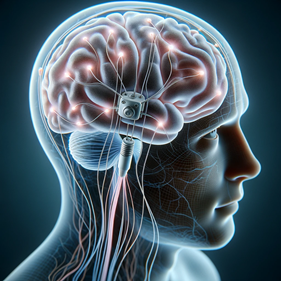
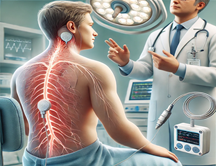
Vagus Nerve Stimulation is an adjunctive treatment for some neurological disorders. The device stimulates the vagus nerve (cranial nerve X) to send electrical signals to the brain. It is used to treat epilepsy, depression, and post-stroke rehabilitation. VNS has been shown to affect blood flow to different parts of the brain and affect neurotransmitter systems including serotonin, norepinephrine, and GABA. The right vagus nerve is not usually used because its stimulation is more likely related to the heart function. Although it is safe for most people but also it has some risks, both from the surgery to implant the device and from the brain stimulation. There also are newer, noninvasive vagus nerve stimulation devices that do not require surgery. Due to the high distribution of vagus nerve target areas, the highly specific function modulation cannot be achieved.
- Electroconvulsive Therapy (ECT)
Electroconvulsive Therapy involves administering brief electrical impulses to the brain while the patient is under anesthesia. It is most often used for people with depression or bipolar disorder who have not responded to other treatments. The main benefit of ECT is its rapid onset of action.
- Magnetic Seizure Therapy (MST)
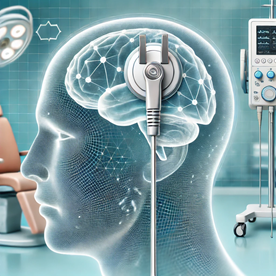
Magnetic Seizure Therapy can produce beneficial seizures in psychological patients, for example, depressed people. The Magnetic field that passes through the scalp and skull can induce a seizure. It has fewer side effects than ECT but better control over the seizure should block its distribution to other sites of the brain.
- Transcranial Magnetic Stimulation (TMS)
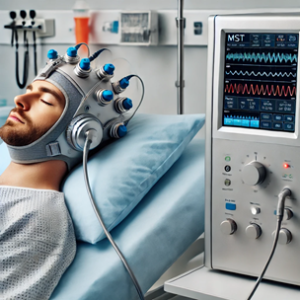
Transcranial Magnetic Stimulation uses a coil of wire placed close to the head to send powerful but very brief magnetic pulses directly to specific areas of the brain. Thus safely and painlessly inducing tiny electric currents in a person’s neural circuitry. Electrical energy in the copper wire coil is converted into magnetic energy, which is then converted back into electrical current within the brain’s neurons.
There are several types of TMS used in clinics: High-Frequencies Repetitive Transcranial Magnetic Stimulation (HF-rTMS), Low-Frequencies Repetitive Transcranial Magnetic Stimulation (LF-rTMS), Single-pulse TMS and Paired-pulse TMS. In general, rTMS produces longer-lasting effects that persist past the period of stimulation and can increase or decrease the excitability of the neurons depending on the intensity of stimulation, coil orientation, and frequency. Low-frequencies rTMS (< 1 Hz) usually have an inhibition effect on neuronal firing, whereas high-frequencies rTMS (> 1 Hz) provoke it.
Due to the indirect electrical connection, TMS has fewer side effects, but unfortunately can excite only the surface cortex of the brain because magnetic field strength falls off sharply with distance from the coil
- Transcranial Direct Current Stimulation (tDCS)
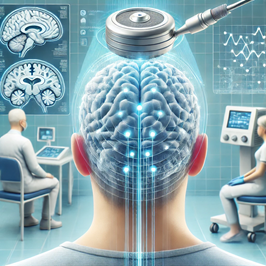
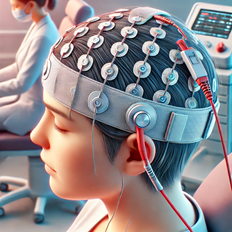
Transcranial Direct Current Stimulation (tDCS) is a brain stimulation method that produces excitatory or inhibitory effects in the brain. In this type of stimulation, low direct current is delivered through electrodes placed on the head. cathodal current leads to down downregulation of neuronal firing whereas anodal current upregulates it. Stimulation durations range between 5 and 30 min, with a current intensity between 1 and 2 mA. This current alters neuronal resting membrane potentials. There are several types of current stimulation including tDCS (direct current stimulation), tRNS (random noise stimulation) and tACS (alternative current stimulation).
Unfortunately, stimulation duration can alter the effect of polarity. For example, after approximately 26 min of anodal stimulation, an inhibitory effect resulted rather than excitation. Moreover, 2 mA cathodal stimulation for 20 min has been shown to result in excitatory changes. In addition, due to the shunting effect, the current concentration reaches the brain region is decreased.
- Transcranial Ultrasound Stimulation (TUS)
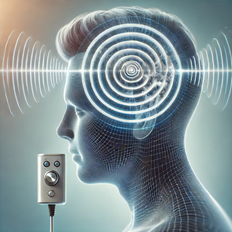
Transcranial Ultrasound Stimulation is a type of brain stimulation that uses ultrasound to stimulate the brain, the effect of which is increased blood flow to certain areas, leading to improved performance in these brain regions. High stimulation intensity and/or rate may cause hemorrhage, cell death or damage and unintentional blood-brain barrier (BBB) opening.
As mentioned earlier, the available technologies to study the brain are very limited. Any tool that helps us to explore the brain, brings hope for a better future. Of course, no one says it would be easy!